
Back in June, I asked my sister Jessica whether she understood the educational videos I’d been making. She said, “Not at all.” I wrote a whole post about it:
My Sister Said My Videos Made No Sense.

I asked my sister if she liked the educational videos I’d been making. She said they were nice. So I pushed: did you actually understand them? She said, “Not at all.”
I promised that from then on I’d make things for her, the smart, curious, busy person who owes me no patience, and that before I published anything, I’d send it to her and ask the only question that counts: did you understand it?
This is the post where I keep that promise. It did not go smoothly.
Jessica and I have also been looking for a way to work together. She writes fiction. I think about how people learn. On paper, that’s a Venn diagram with a very small middle, which is a strange thing to say about your own sister. So we went looking for the middle.
We found it in Amy.
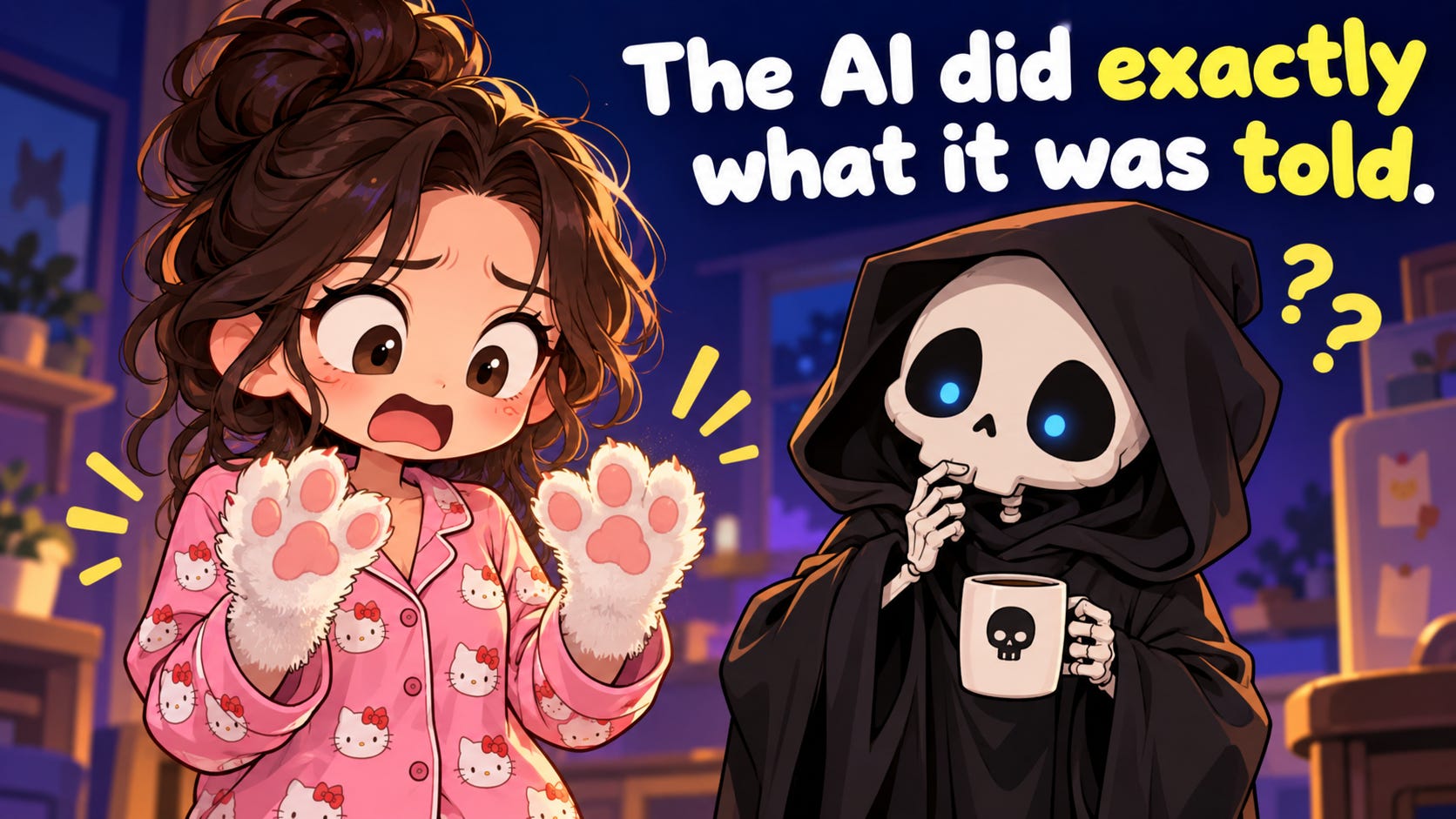
Amy is the main character in “An Unfortunate Error in Judgement,” a short story Jessica published on her Substack in April under the name J. Davis Mallory. Amy is fourteen. She falls asleep in her Hello Kitty pajamas and wakes up in a house she doesn’t recognize. She follows a sliver of light down the hall to the kitchen, and there sits the Grim Reaper, drinking coffee. When she knocks over a vase, his first reaction is to yell, “You better not have broken another vase, Carl!”
Carl, it turns out, is Grimm’s apprentice. Carl collected Amy sixty years early. (Her grandmother was the one who was supposed to go.) It only gets worse from there, and the ending made me say “oh no” out loud. Go read it. I’ll wait.
Jessica writes about a lot more than reapers with coffee habits. Her Substack also covers life with muscular dystrophy, a memoir in progress, and her love of anime, sci-fi, and fantasy. If you want to know her better, start there: jdavismallory.substack.com.
From story to comic
The tool I built is called Panel Pipeline. It’s based on David Garrido’s comic script workflow. You paste in a story and it turns it into a comic script: the story split into pages, each page split into panels, and each panel told what to draw, who is talking, and what sound effects go where. Then you hand that script to Gemini Notebook (formerly NotebookLM), and it draws the pages.
Jessica’s story was the obvious first test. Who better to judge a comic about Amy than the person who invented Amy?
My sister reports back
This time she skipped “nice” entirely. She ran her story through it and sent me this, which I’m quoting because I can’t improve on it:
“Amy’s image is not the same in each frame. Her hairstyle differs, her age changes, her clothes change, the art style changes, and sometimes she looks like she has cat paws.”
Also, Grimm didn’t look chibi. And Rachel (also our sister), who was testing it too, was lost.
So, to recap: the author could not recognize her own main character, and she told me so without softening a word. That is not the review you want. It is exactly the review I needed.
Why Amy kept changing
Here’s what I learned, and it’s the part I most want people to take away.
AI draws every page from scratch. It doesn’t remember the page before. If all it has is a description in words, it fills in whatever the words leave out, and it fills them in differently every time. Hair, age, clothes: all up for grabs, page after page. It’s like a TV show recasting Aunt Viv between seasons and hoping you won’t notice. You notice.
The cat paws were my fault. My tool described Amy four different ways in four different places, and one of them said her pajamas had “cat paw prints.” The AI read that as literally as possible and gave a fourteen-year-old girl actual paws. Grimm was described as a “towering skeleton,” so of course he came out tall and realistic instead of cute. The AI didn’t misread anything. It did exactly what it was told. I just hadn’t been clear, which, as a former math teacher, I find personally humbling.
Jessica’s fix
Jessica had the answer before I did. Her suggestion: “I am wondering if you have to create the character images first and then develop the story.”
Yes. That’s it. Before you make a single comic page, you make one picture of your characters. Then you give the AI that picture to copy on every page. A picture doesn’t leave gaps the way words do.
That idea became the backbone of the redesign. The site now has four steps, and step two, “Draw your characters,” is the one everything depends on. You ask ChatGPT or Gemini for a character sheet, you check it carefully, and then you upload it to Gemini Notebook along with your script. I also cleaned up every description so each character is described exactly one way, and so that “no paws, no cat ears” is written down where the AI can see it.
Making it make sense (again)
Her other note was the one that stung. People need to understand what AI is, and the instructions had to be simpler. It took her a minute to figure out what to do. Rachel was lost.
Reader, I wrote an entire post about the curse of knowledge in June. And then I built a page that made sense to exactly one person: me. Apparently I needed to learn that lesson twice.
So I cut. The site now has four plain steps: pick a story, draw your characters, check your script, and make the pages. There’s a short “What is AI?” explanation at the start for people who haven’t used these tools before. Each step also has a short narrated video with captions, so you can watch someone walk through it instead of reading a wall of text. If a tool only works for people who are already comfortable with the technology, it doesn’t work.
Behind the scenes (the short version)
I didn’t build this alone. I directed three AI tools. Claude built and repaired the site and assembled the how-to videos using a video framework called HyperFrames. ChatGPT made the slides and the character sheets. The funny part is that the AI tools made the same mistakes this whole post is about, and I had to catch them. One Grimm sheet came back eight feet tall and realistic. One slide said Amy was twelve. One storyboard asked for Grimm in the kitchen and drew a black cat. Checking the AI’s work turned out to be the actual job. I’ll write a full post on how the videos got made, because it deserves one. This is an overview of how it works that was generated by HyperFrames.
What’s next
Jessica and I are still figuring out what we’ll build together. Amy was our first try at finding that middle, and it taught us both something. I learned my tool wasn’t as clear as I thought. Jessica got to watch her character go through several unplanned costume changes. Working with my sister on something we both care about was the best part.
If you want to try it, the site is here: akesha.github.io/graphicNovel. Start with Amy, since she’s already set up for you. Just check her feet.
And before this goes up, I’m sending it to Jessica. You know the question.
Update: I think I wore her out with testing. She hasn’t responded to my last update in more than 24 hours... but I know where she lives.
Twenty-four hours of silence from my most honest tester is its own kind of feedback. It might just mean “I’ve been a comic, a character guide, and a quality assurance department this week, and I need a nap.”
I've been following your sister's substack for a while now, thanks to your recommendation, but I had not seen her short story yet - so thank you again! I love that you are collaborating on this.
Correction... I didn't use my voice in eleven labs, I used my voice in another project (a song) which will be discussed later.