I Built a Video Avatar.
Then I Read the Pope’s AI Encyclical.

I was in a video editing class. The kind you take because the algorithm is convinced you should and, for once, the algorithm is right. The instructor thoughtfully walked us through a tool that builds a personalized avatar: your face, your gestures, a voice that resembles yours but isn’t yours, all stitched together by the machine. I made one. It was good. Better than good. It did things I cannot do with a webcam and a ring light, and it did them in the time it would take me to find the ring light.
I should mention that I have written, more than once, about my concerns related to

having my voice appropriated by AI for ends I would never consent to. About the way synthetic audio of Black women’s voices, in particular, gets used in scams, in deepfakes, in the small daily violences the internet has made cheap. I am, by my own published record, a person who is suspicious of the thing I just built.
I loved what I made. I also closed the laptop and felt a little sick.
Two things in the same breath. That is the place I was sitting when I read Pope Leo XIV’s Magnifica Humanitas.
I want to say first what the document does. This is not a throwaway. Leo XIV chose his name to put himself in a line with Leo XIII, who published Rerum Novarum on May 15, 1891. The new encyclical is dated May 15, 2026, the 135th anniversary, which is to say Leo XIV is locating his AI document inside the longest-running serious conversation the Catholic Church has had about how technology rearranges power. He is taking AI as a spiritual question, not only an ethical or technical one. He names the technocratic paradigm, the tendency to let “the logic of efficiency, control and profit alone shape personal, social and economic decisions” (paragraph 92). He names what most policy documents will not say out loud, that the speed of AI development is “armed competition” (paragraph 110), driven by geopolitical and commercial dominance, and that calling for ethics-on-top is not enough if the moral framework gets written by the same people who control the data centers.
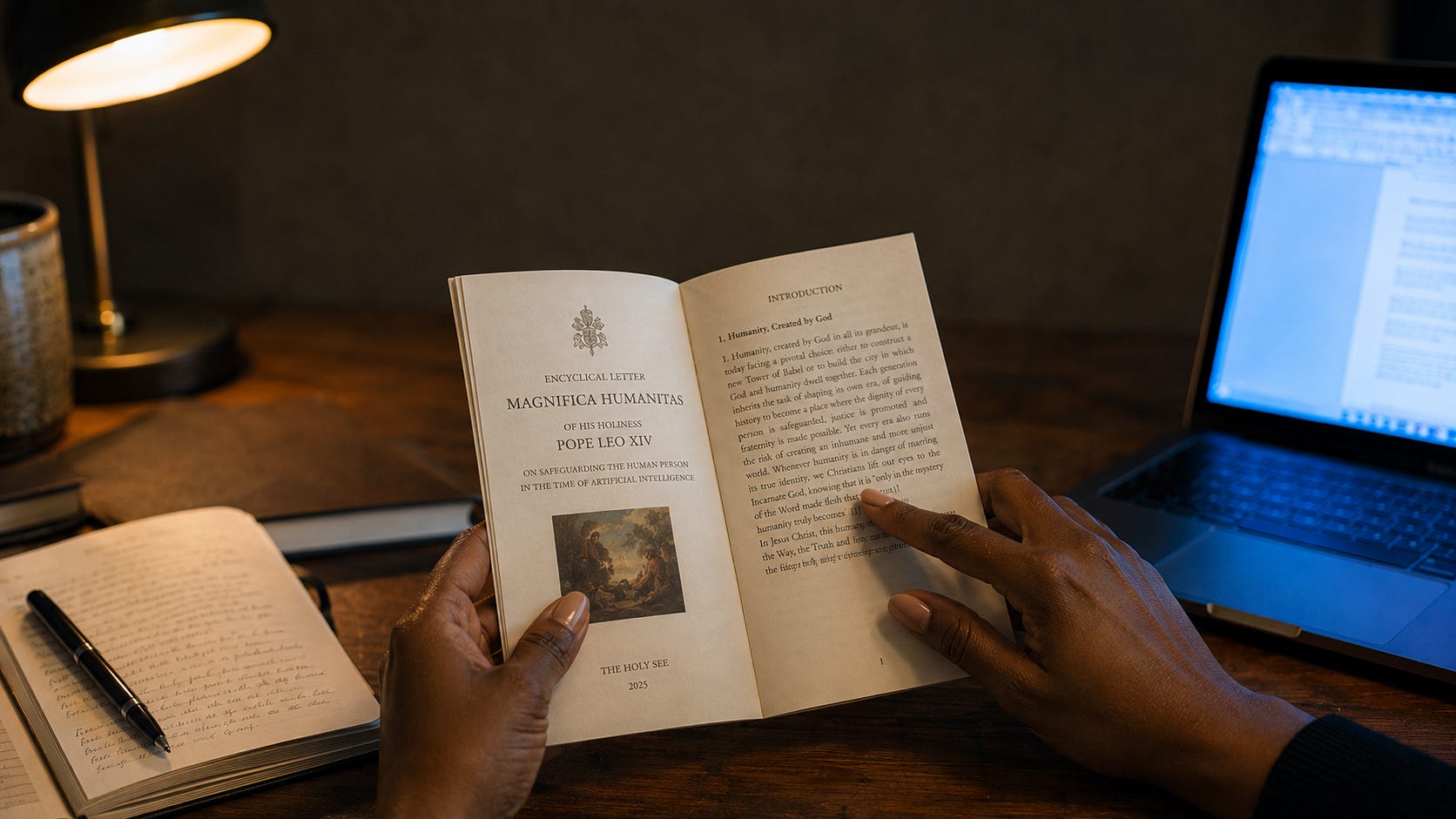
Two paragraphs really stand out. Paragraph 173 is where the encyclical names the hidden labor: the millions of people, “predominantly women,” doing data labeling and content moderation under brutal conditions, often exposed to the worst of what the internet produces, and the children and adolescents mining the rare earths so the chips can be made. Paragraph 178 names the next colonialism, with data as the new rare earth, extracted from regions of “structural fragility” without their consent, used to train models that will not serve them. These are not gestures.
This is a Pope, on the record, saying that the systems many of us use to write, to teach, to schedule, to build avatars, rest on a chain of exploitation the Catholic conscience cannot pretend not to see.
That mattered to me. I want to be clear about that before I say what I think is missing.
Where the document comes closest to my actual work is its chapter on schools. The Pope writes, in paragraph 140, that “schools are not called to follow the pace of the digital world, but to offer that which the digital sphere by itself cannot provide, namely a shared time for learning and developing trustworthy relationships.”
Yes. Exactly.
He calls for an educational alliance among policy-makers, institutions, and families (paragraph 142), and warns that the asymmetry between business models that monetize attention and parents trying to raise children cannot be solved by telling families to try harder.
I have spent fifteen years thinking about how people learn, and that paragraph names what schools are for. The diagnosis is right. The thing that is being asked of schools is also right.
And.
Here is what the document does not quite hold.
The students sitting in front of a faculty member I support next semester will graduate into a labor market that has already laid off the analyst, the paralegal, the copywriter, the customer service rep, the junior developer, the graphic designer, the translator. Not because those people did anything wrong, but because their employer bought a tool six months earlier than they expected to need it and decided it was cheaper to keep three people than seven. This is the last two years of headlines. The cost of “not following the pace” is being paid by individuals, in real time, with their paychecks.
So when the Pope tells schools not to chase the pace, I find myself wanting to ask: which pace? The pace of the model release cycle, no, do not chase that, that way lies a workshop on a tool that will be deprecated by the time the syllabus is approved.
But the pace at which AI fluency is becoming a hiring criterion? Students cannot afford to opt out of that race, and neither can the adults in continuing education, and neither can the adjunct teaching the AI literacy unit on top of a 4/4 load with no release time. The encyclical’s response to job displacement (paragraphs 151 through 156) is correct on the principles. It calls on the State and on international cooperation to absorb the cost of transition. It is also being read in a context where the State is not absorbing it, and employers are not absorbing it, and so the cost lands on the person who got the email about restructuring on a Tuesday afternoon.
This is the pressure the document names but does not, I think, quite sit with: the people it is talking to are not standing outside the system. We are inside it. I am inside it. I built the avatar. I will probably use it for something. I am also the person who has read paragraph 173 and cannot un-read it, and who lives in a small rural town that data centers are coming to surround. The cooling. The water. The grid. The land. None of this is abstract to me, and almost none of it is something I, individually, can opt out of by not using ChatGPT for a week.
The encyclical’s moral framing keeps the user at arm’s length from the tool. It writes as though the reader is being warned about an environment they might choose to enter.
Most of the document’s actual readers, including most Catholics with consciences who cared enough to read a 245-paragraph encyclical, are already inside the environment. We are using these systems for work we cannot afford to stop doing. We are teaching with them, in some cases, because the next class of students will be hired by people who expect them to know how. We feel both the lift the tool gives us and the weight of what it costs. The document does not yet have a category for that person.
I am not asking for permission. I am asking for honesty about where the addressee is standing.
If we are inside the system the encyclical is warning us about, we are not the first to be.
The encyclical names Martin Luther King Jr. exactly once, in paragraph 124, in a list of “individuals who truly took the dignity of everyone seriously.” It is the kind of mention King gets in most papal documents: lifted up as a moral exemplar, briefly, in the abstract. Inspiration without analysis. Icon, not argument.
But King had this argument. The actual one. Decades before Magnifica Humanitas named the technocratic paradigm, King was naming it, from a Riverside Church pulpit and from inside the long discipline of the Black Church.
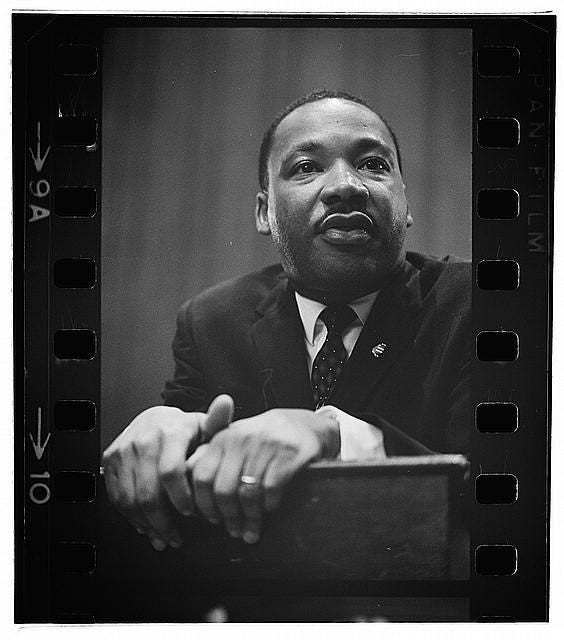
In Strength to Love (1963), King wrote: “Our scientific power has outrun our spiritual power. We have guided missiles and misguided men.” That sentence does the same work the encyclical’s chapter on the technocratic paradigm does, in eighteen syllables.
In “Beyond Vietnam,” delivered at Riverside Church on April 4, 1967, exactly one year before he was killed, King said: “When machines and computers, profit motives and property rights are considered more important than people, the giant triplets of racism, extreme materialism, and militarism are incapable of being conquered.” Read that next to paragraphs 92 through 96 of the encyclical. They are saying the same thing, in nearly the same words, 59 years apart. The encyclical does not cite King here. It should.
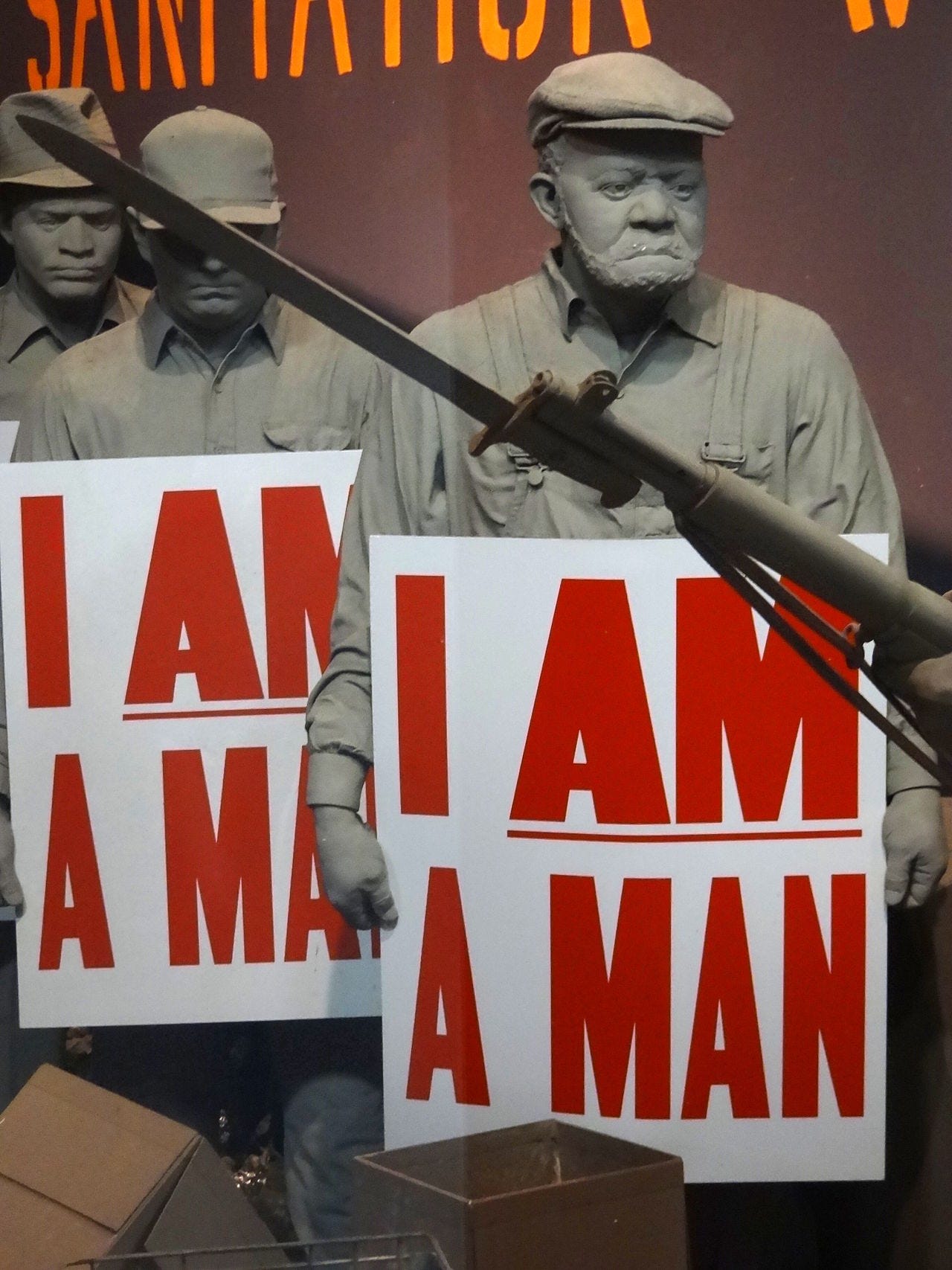
And then there is Memphis. King was killed in April 1968 because he had gone to support the sanitation workers’ strike. Black men carrying placards that read I AM A MAN. The encyclical’s chapter on the dignity of work is correct. King was killed for the standpoint that produced it. The papal critique and the Black prophetic critique converge on the diagnosis. They do not converge on the cost paid to make it.
I want to name a tension here, because I am a Black Catholic and I cannot pretend it isn’t in the room. King’s theology was forged in the Black Baptist tradition, in a specific Southern Black experience of struggle. It does not sit neatly under a Roman frame. There is something uncomfortable about citing him inside a piece about a papal encyclical, as though the Magisterium gets to fold his prophetic voice into its own lineage and call it ecumenism. I notice that discomfort. I am writing through it on purpose, because the alternative is to let the document mention King in paragraph 124 and let no one ask why his actual argument is not the spine of it. The two traditions are not interchangeable. Placing them side by side is not synthesizing them; it is refusing to let one stand in for the other.
If the encyclical wants the dignity tradition King died for, it has to mean more than putting his name in a list.
There is one more thing the encyclical, and most of the AI discourse it joins, keeps doing that I want to name.
It treats AI as the defining problem of our moment. Not a problem. THE problem. Its 245 paragraphs are organized around it. The “new things” of our era are, almost by definition, AI things. Even the chapters on work, war, and education orbit it.
When we frame every problem as an “AI problem,” we let the older structures off the hook.
The encyclical names data colonialism (paragraph 178) and labels it new. But extractive capitalism did not start with data. It started in the silver mines of Potosí and the cotton fields of Mississippi. The encyclical names automation’s labor displacement (paragraph 150) and treats it as part of “the fourth industrial revolution.” But automation has been displacing workers since the first industrial revolution. Surveillance capitalism predates ChatGPT by a quarter century. Misinformation predates deepfakes by all of history. The cobalt mines in the DRC were already exploited before they were feeding chip fabs.
This matters because the response we organize matters. If “AI” is THE problem, we get an AI regulation regime, possibly a good one. We may even get a Catholic alliance around AI ethics. And we will, six months later, discover that the underlying disease (what King called the giant triplets, what Catholic Social Teaching since Rerum Novarum has called the disorder of capital over labor) is still here, just wearing different clothes.
The encyclical, to be fair, does sometimes gesture at this. Locating itself in the Rerum Novarum tradition is itself an act of saying “we have been here before.” But its center of gravity, its 245 paragraphs, are organized around AI as the defining “res novae.” Its imagination is AI. Its target is AI. The response it convenes will be an AI response. The framing does work. The framing also does damage, because it can let everyone in the room agree to regulate the new thing rather than confront the old thing.
Instructional design has been running a version of this panic cycle for as long as I have been in the field. Calculators. The internet. Wikipedia. MOOCs. ChatGPT. Each new technology gets framed as the existential threat to learning. Each time, the underlying structural questions (who gets supported, who has time to study, whose knowledge is treated as legitimate, who pays for the tools) stayed in place. The panic served as a heat sink. It absorbed the attention that might have gone to the older, slower, harder argument. By the time we recovered, the next technology was already arriving.
AI is the latest panic. It is also a real thing, with real costs, and I am not arguing that we should ignore it. I am arguing that if it becomes the only frame, we will regulate AI and discover that poverty is still here. Automation is still here. The disorder King and Leo XIII both named is still here. Wearing what comes next. And we will still be standing inside it.
The encyclical closes with the Magnificat, Mary’s song of reversal. The proud scattered. The mighty cast down. The lowly lifted up. The hungry filled. The rich sent away empty.
If we are going to take this document seriously, the song has to reach further than the document quite admits. The Pope points correctly at the developers, at the technocratic mindset, at the lack of regulation. But the institutions calling for the response, the Church, the university, the employer, the state, have not yet absorbed the cost they are asking individuals to absorb. There is no parish-level AI formation am aware of (please correct me if I am wrong). There is no diocesan retraining of priests for the questions their parishioners are actually asking. Most universities are running AI literacy on the unpaid time of faculty who are figuring it out on the side. Most workplaces are passing the cost of fluency through to the employee, whose next performance review will quietly reflect whether they kept up.
The Magnificat is not a poem about somebody else’s reversal. It is a song about the order of the world being turned over, including the parts of the order that the singer benefits from. If the Church and the institutions that share its concern want this document to be more than a beautiful diagnosis, the lift will have to land on their budgets, their staffing, their formation programs, and yes, eventually, their relationships with the data centers being built outside small towns like mine.
I will keep using the tool I just built, with my eyes open about what it cost to make and what it will cost to run, and the other equally important ethical considerations.
I know that is not a clean place to conclude. The encyclical does not promise a clean place. It promises, if I am reading it right, that the Lord has already shown the strength of his arm, and that the song is being sung whether we are ready for it or not.
Maybe the most honest thing I can do, this week, is re-read paragraph 173 out loud.
I find it surprising that the pope commented on AI. I am glad he did, though. I showed mom your AI video. I think it scared her a little bit lol