
She just wants to eat her noodles in peace.
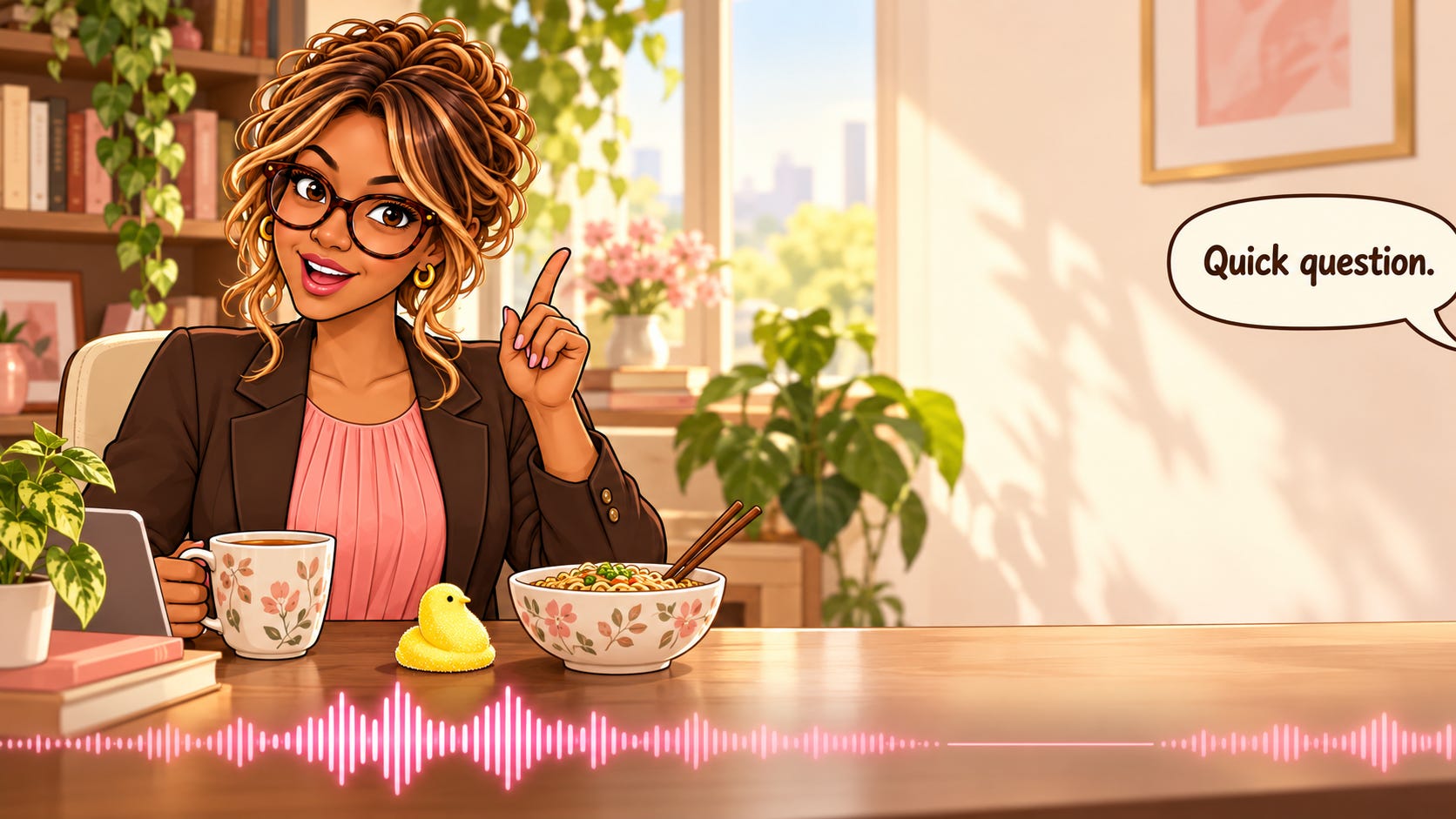
Dr. FunFacts finally sits down for lunch. Tea. Noodles. A marshmallow Peep for emotional support. No meetings. No questions.
Then a voice from just off camera says, “Quick question.”
That is the whole plot of “Just Eat Your Lunch,” a 47-second episode starring the cartoon host of my puzzle game, OutNumbered. This week I made her talk. Her mouth moves on her lines and stays shut on his. And by the end, she is inviting you to play. Getting there taught me more about delegating to AI than I expected.
First, the game
OutNumbered is a daily puzzle game I am building. Every day you get five surprising quantities, and your job is to rank them from least to greatest. That’s it. Five things, one order, and a lot of “wait, really?”
The fun is in the gap between what feels big and what actually is. I review the facts before a puzzle goes live, because a game about numbers has to get its numbers right. Though I still fear making a mistake.
Dr. FunFacts is the host. She is a cartoon version of me: a little smaller, different hair, same tortoiseshell glasses, same refusal to let a good fact go unshared.
This episode doubles as a sample round. The laptop on her desk holds a lunch-themed round: stadium seats, a Peep, a cup of tea, an envelope, and a bowl of noodles. Her friend asks what those things could possibly have to do with each other. That question is the whole game.
What I walked in with
I did the creative work first:
Six illustrations of Dr. FunFacts at her desk: eyes closed in relief, presenting the Peep, showing a laptop with five puzzle clues, pushing up her glasses, side-eyeing over a spoon, and posed under a “Play OutNumbered” title.
One finished soundtrack. Two voices (ElevenLabs), her and an offscreen friend, with music already mixed (Suno) underneath.
A shot-by-shot script with the exact second every line starts and stops.
What I did not have was a way to make a still drawing say a line. That was the job I handed off.
The decision that made it work
In AI video tools, the model moves the mouth for every voice it hears.
If I had handed it my full soundtrack, Dr. FunFacts would have mouthed her friend’s lines too. She would have lip-synced the music. The whole joke depends on her sitting there, mouth closed, while someone else interrupts her lunch.
So I had Claude split the soundtrack. For each shot, I gave the model a clip with only her lines. Every one of his lines became silence. She talks when she talks and listens when he talks.
Then, in the final edit, the original soundtrack went back underneath everything, unchanged. His voice returns, the music returns, and because his lines lare delivered while her mouth is closed, he reads as a friend standing just off camera. Nobody drew him. He exists by subtraction.
That was not a prompt trick. It was a design decision about what the model was allowed to hear.
The tea: what went sideways
This was not a one-click miracle. Here is what actually happened.
The files would not go where they needed to go. I worked with Claude, and its workspace could not reach the video platform’s upload server. Neither could the shell on my laptop. I ended up uploading every image and audio clip by hand through the platform’s own upload box. Then I downloaded every finished clip by hand too.
Two pictures got swapped. When the files were renamed by shot, the Shot 1 and Shot 2 images were switched. The first test clip started on the wrong drawing. I watched it and kept it anyway, because her eyes happen to be closed on “Lunch. Finally.” Sometimes the mistake is the take.
The model loosened the poses. I asked for her original framing. In a few shots she drifts: chin off her hand, hands on the bowl. Her face, glasses, hair, blazer, and the Peep stayed consistent.
Two clips started talking late. In two shots, her speech began a fraction of a second after it should have. We measured the delay and trimmed the clips so her mouth lands on her words.
She touched the Peep. The script said the Peep stays untouched. In the last shot she gives it a little pat. I am calling it affection.
The receipts
Here is what it took.
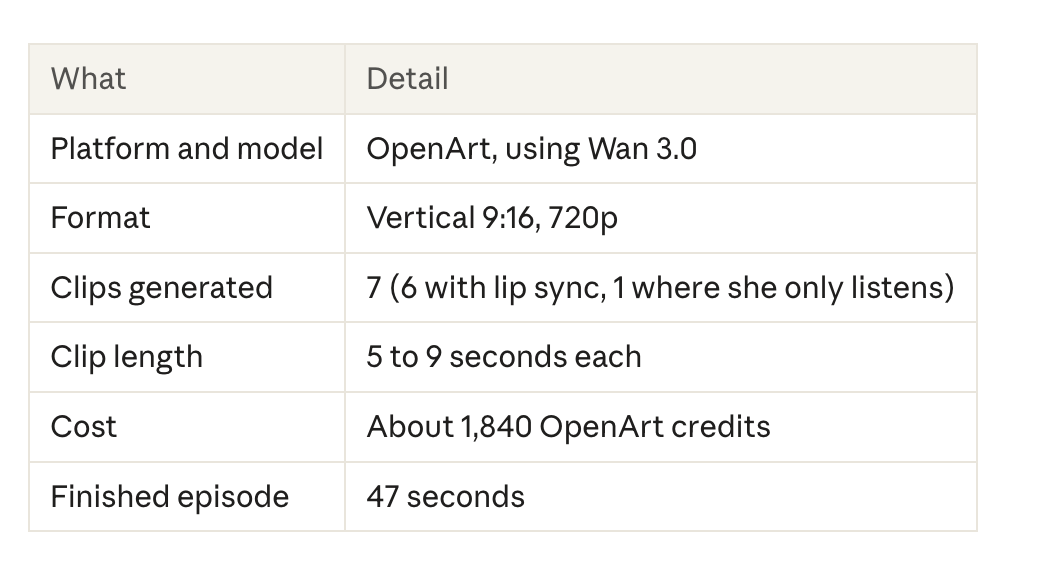
I did not spend it all at once. I paid for one test shot first, about 324 credits, and only ordered the rest after it passed.
Passing meant two checks. First, the audio in each clip was compared against her original lines to confirm the timing matched. Second, we pulled still frames at moments when she should be talking and moments when he is talking. Mouth open on hers. Mouth closed on his. Every shot.
What this means if you teach with AI
The model did the drawing. It did not make the decisions that made the episode work.
The decisions that mattered were human ones:
Deciding what the model should hear. Her voice only. That one choice did more than any prompt.
Testing small before spending big. One shot, checked, before six more.
Checking the output against the original. Not “does it look good,” but “does her mouth move on her words and stay still on his.”
Deciding which flaws to keep. The swapped picture stayed. The late audio got fixed.
That is the same move I want from students and faculty. Delegate the production. Keep the judgment. Then be ready to defend every choice, including the ones the tool made for you.
So here is my question for you this week: in the last thing you handed to AI, what did you let it hear that it should not have?
Think it looks easy? Play OutNumbered. Rank five surprising quantities from least to greatest. The link is in the video description: https://youtube.com/shorts/hIzUTog95os
And if you want more behind-the-scenes builds like this one, subscribe. The tea is always hot.