Pedagogical content knowledge is real.
Teaching expertise does not come free with a key to the room


Paul Schofield’s essay against teaching and learning centers featured in the Chronicle of Higher Education is making the rounds in my corner of academic social media, and I understand why. The prose is clean. The parable is seductive. The Leibniz anecdote, where he knocks on a senior colleague’s door and they puzzle through the hard passages together, reads like a love letter to what university teaching is supposed to feel like.
If you read the piece and wondered whether your institution’s teaching center is administrative bloat or an actual partner in your work, the question is worth taking seriously. After fifteen years supporting faculty at an R1, I think Schofield’s argument is undermined by his own best example, and that is worth unpacking if we want to talk honestly about what teaching centers should do.
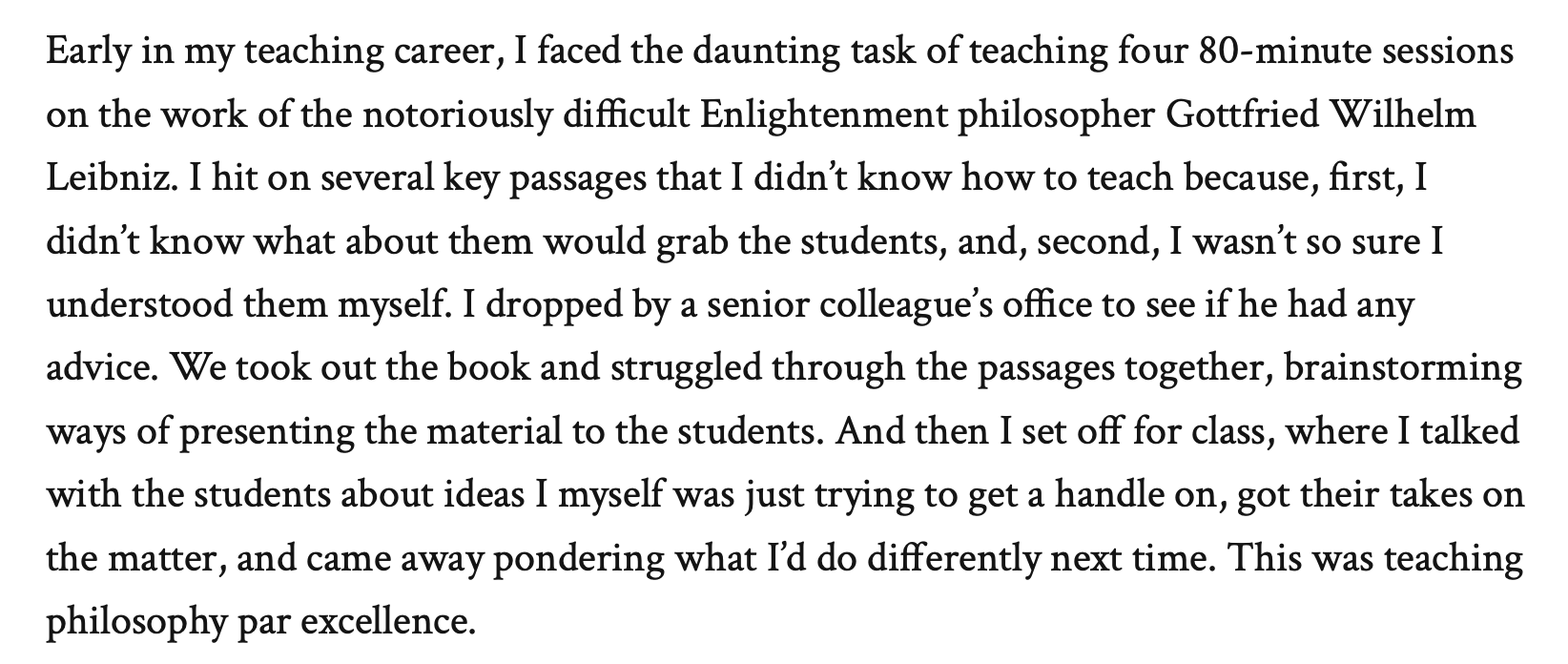
Here’s the problem. Read the Leibniz passage again. Schofield went to his colleague for two reasons: he did not know what about the passages would grab his students, and he was not sure he understood them himself. The two of them then brainstormed “ways of presenting the material to the students.” Schofield went to class and deliberately modeled inquiry in front of his students. This is pedagogical work of the highest order. Lee Shulman had a name for it nearly forty years ago: pedagogical content knowledge, the fusion of subject matter with the craft of making it learnable (Shulman, 1986, 1987). Schofield’s “teaching philosophy par excellence” is a pedagogical coaching session that happened to take place in a hallway.
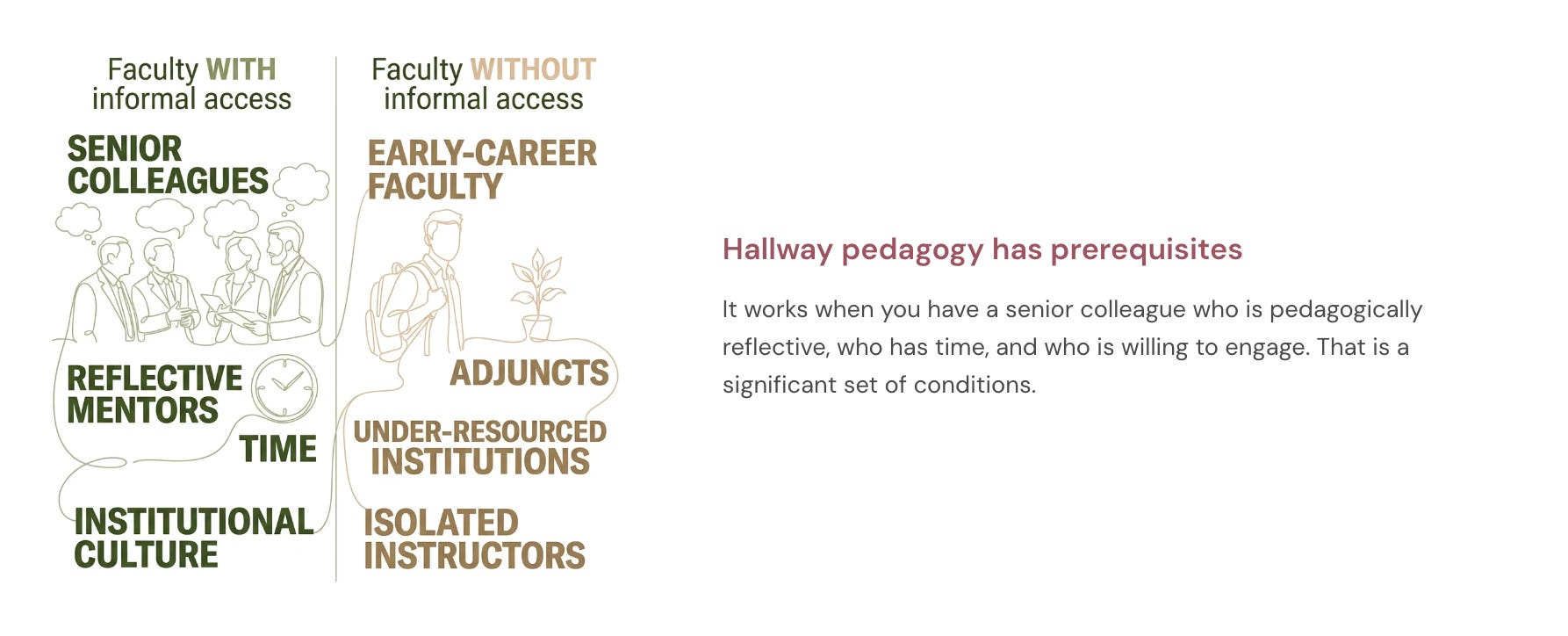
So the real question is not whether this kind of expertise exists. Schofield’s essay demonstrates that it does. The real question is who has access to it. Hallway pedagogy works when you have a senior colleague who is pedagogically reflective, who has the time, and who is willing to spend an hour struggling through Leibniz with a new hire. Plenty of early-career faculty, adjuncts, instructors at institutions without that culture, and faculty in departments where senior colleagues have retreated from teaching do not have this. Teaching centers exist, in part, because hallway pedagogy is unevenly distributed.
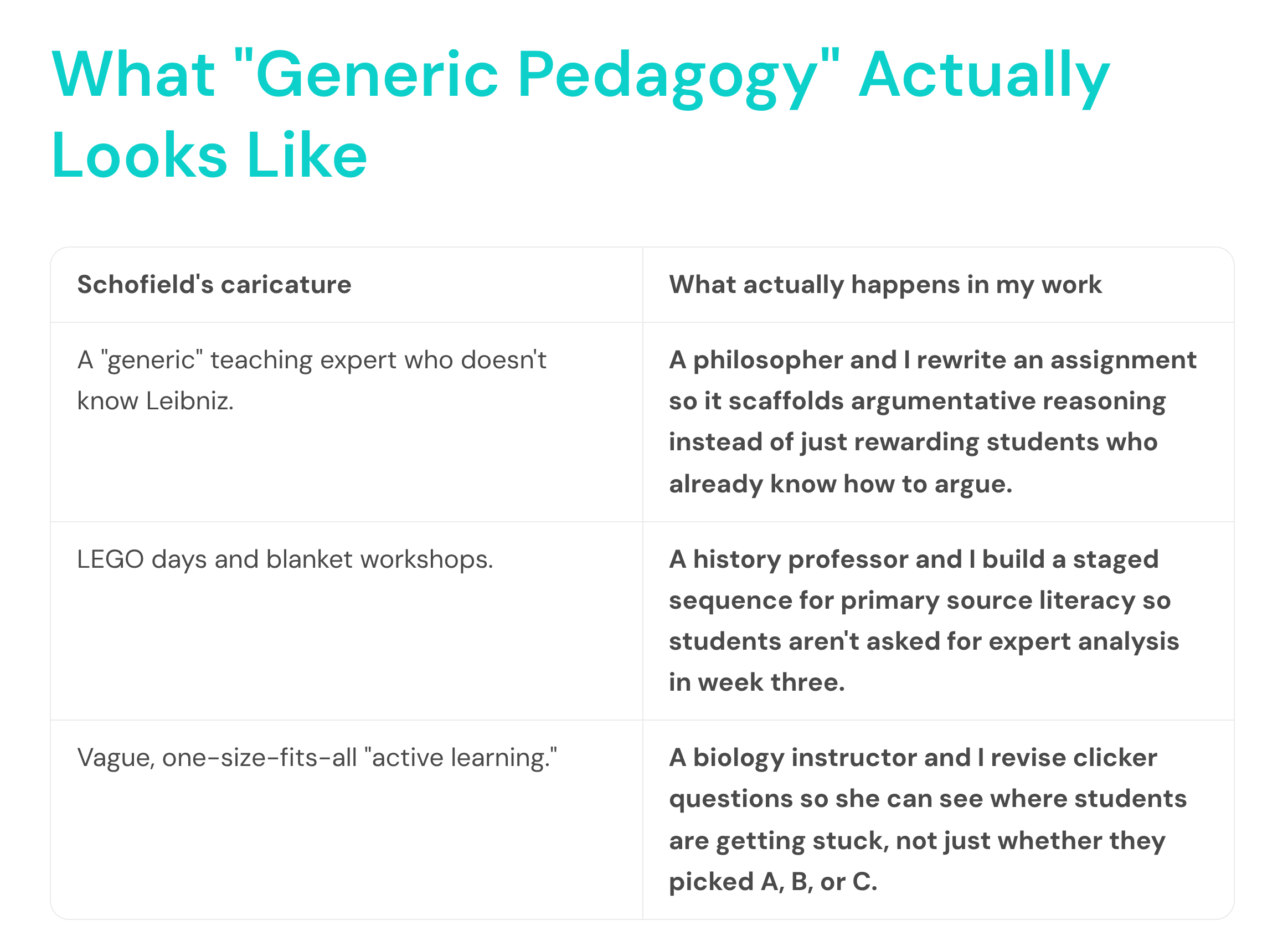
I know this because I have been on both sides of that hallway. I was a math teacher before I was an instructional designer. Spectacularly struggling and sometimes failing at that task is what made me want to learn HOW we learn. Turns out philosophy, cognitive science, educational psychology, ed tech, and information literacy, and a few other disciplines all contribute to the science of good teaching. I have stood in front of a class trying to explain something I was still figuring out myself. I have also spent fifteen years as the person down the hall, helping faculty do what Schofield’s colleague did for him. The caricature of LEGOs, blankets, and scaffolding jargon only holds if you never look directly at what centers actually do.
When I sit down with faculty in my center, the work is specific.
What “generic pedagogy” actually looks like
The work spans disciplines in a different way, too. I help faculty see when “rigor” is functioning as a euphemism for attrition. I help them integrate AI into coursework without either banning it or surrendering to it. I help them notice that the students in their classrooms today are different from the students who filled those seats ten years ago, and that the teaching that worked then is not working equally well now.
Schofield’s strongest-sounding claim is that there is no generalist teaching expertise, only discipline-specific teaching. He is half right, and his own example proves the other half. Pedagogical content knowledge is discipline-specific, and Schofield and his colleague were doing it for Leibniz. But PCK is not something a department transmits through membership alone. It develops through sustained reflection on how students actually move through a body of material, through trial and revision, through the kind of conversation he describes. That reflection is what teaching centers scaffold at their best, across disciplines and career stages, not just for the faculty fortunate enough to have a pedagogically generous senior colleague with an hour to spare.
Historians at Indiana University named this phenomenon when they built the Decoding the Disciplines project (Pace & Middendorf, 2004; Middendorf & Shopkow, 2018). The project rests on the premise that disciplinary expertise is precisely what makes faculty bad at explaining their reasoning to novices. Experts internalize moves they cannot consciously retrieve. Sam Wineburg (2001) makes the same point about historians: they read primary sources in ways undergraduates cannot replicate until someone walks them through the moves. The work of unpacking those moves, identifying where students get stuck and why, is not something a discipline teaches itself through senior-to-junior transmission. It is pedagogical work, and it benefits from people trained to do it.
His evidence critique also cuts both ways. If learning styles is flimsy, and it is (Pashler, McDaniel, Rohrer, & Bjork, 2008), then a senior colleague’s hallway advice is flimsier by the same measure. It is an anecdote with no control and no accountability. The broader claim that pedagogical research doesn’t hold up is simply wrong.
Consider the evidence base Schofield dismisses. Freeman et al. (2014) meta-analyzed 225 studies and showed that active learning reduces failure rates in undergraduate STEM from 34% to 22%. Theobald et al. (2020) extended this finding to show those gains are largest for the students most at risk of leaving. In the humanities, the quantitative evidence base is thinner because we have not funded it, not because it does not work. Ken Bain’s cross-disciplinary study of high-impact college teachers (Bain, 2004) and the multi-institutional research on writing pedagogy from the Consortium for the Study of Writing in College (Anderson, Anson, Gonyea, & Paine, 2015) show that specific teaching moves produce measurably different learning outcomes in humanities contexts too. The answer to patchy evidence is better studies, not fewer studies, and teaching centers are among the few places in the university actively funding humanities-focused pedagogy research at all.
He is right about some things, and I will give him this. Some teaching centers do run thin programming. Some do not have people who have experienced the struggle of promotion and tenure while trying to do research and teach well. Value capture is real, and measuring teaching by workshop attendance is the kind of metric that eats the thing it claims to track (Nguyen, 2026). Pedagogical jargon is sometimes a substitute for thinking, and any honest instructional designer can tell you which workshops at their own institution they would not attend voluntarily.
The answer is to demand better centers, not to abolish the category. The answer is to ask what the work is for and what we would measure if we took student learning seriously. The answer is not to retreat to a version of teaching that worked for the professor who was already the expert, and leave everyone else to figure it out on their own time.
If you are a faculty member who found Schofield’s piece compelling but still has a course to teach next term, there are places to start:
Bring one real assignment to a teaching center and ask what it actually scaffolds and who it leaves out.
Run one small experiment with active learning this semester and track what happens to your failure rates, rather than treating the practice as a yes/no ideological choice.
Ask your center how they measure their impact beyond workshop attendance. If they do not have an answer, that gap is the beginning of a better conversation, not a reason to shut the doors.
Schofield closes by saying we should leave the teaching to those who spend their days in the classroom. I agree. But teaching expertise does not come free with a key to the room; it’s something we have to build, study, and support.
References
Anderson, P., Anson, C. M., Gonyea, R. M., & Paine, C. (2015). The contributions of writing to learning and development: Results from a large-scale multi-institutional study. Research in the Teaching of English, 50(2), 199–235.
Bain, K. (2004). What the best college teachers do. Harvard University Press.
Freeman, S., Eddy, S. L., McDonough, M., Smith, M. K., Okoroafor, N., Jordt, H., & Wenderoth, M. P. (2014). Active learning increases student performance in science, engineering, and mathematics. Proceedings of the National Academy of Sciences, 111(23), 8410–8415.
Middendorf, J., & Shopkow, L. (2018). Overcoming student learning bottlenecks: Decode the critical thinking of your discipline. Stylus.
Nguyen, C. T. (2026). The score: How to stop playing somebody else’s game. Penguin Press.
Pace, D., & Middendorf, J. (Eds.). (2004). Decoding the disciplines: Helping students learn disciplinary ways of thinking (New Directions for Teaching and Learning, No. 98). Jossey-Bass.
Pashler, H., McDaniel, M., Rohrer, D., & Bjork, R. (2008). Learning styles: Concepts and evidence. Psychological Science in the Public Interest, 9(3), 105–119.
Shulman, L. S. (1986). Those who understand: Knowledge growth in teaching. Educational Researcher, 15(2), 4–14.
Shulman, L. S. (1987). Knowledge and teaching: Foundations of the new reform. Harvard Educational Review, 57(1), 1–22.
Theobald, E. J., Hill, M. J., Tran, E., Agrawal, S., Arroyo, E. N., Behling, S., … Freeman, S. (2020). Active learning narrows achievement gaps for underrepresented students in undergraduate science, technology, engineering, and math. Proceedings of the National Academy of Sciences, 117(12), 6476–6483.
Wineburg, S. (2001). Historical thinking and other unnatural acts: Charting the future of teaching the past. Temple University Press
One point I forgot to add is that he argues "The presence of a teaching and learning center, however, introduces a kind of gravitational force away from a colleague’s office". When many centers make it a point to create faculty learning communities that offer faculty opportunities to connect with faculty they may never organically connect with otherwise.
I'd like to see this published in The Chronicle as a response!