The AI "X" Factor
What’s left of teaching after Artificial Intelligence takes the easy half

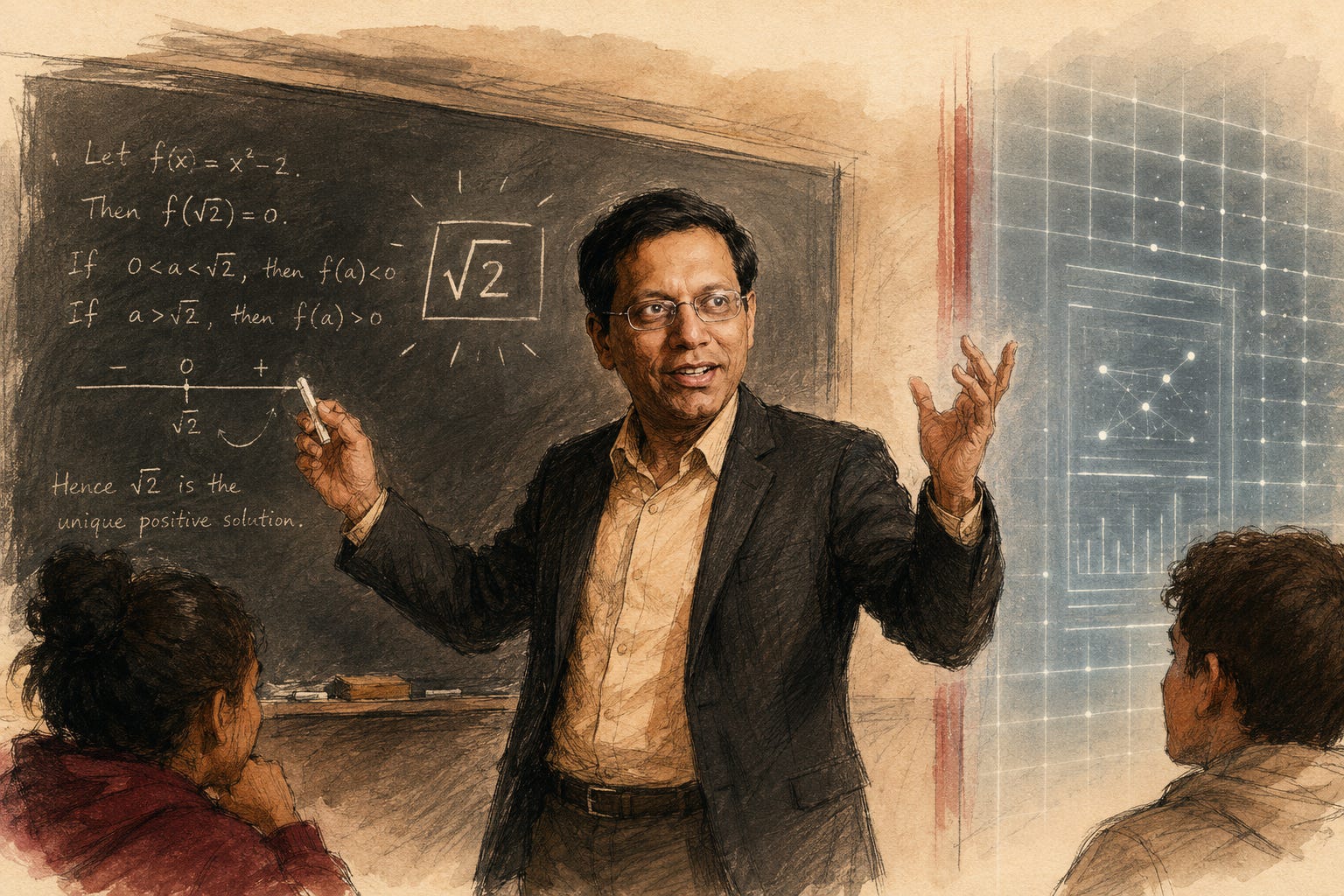
A math professor stood in front of his class, finished proving that the square root of two is irrational, and nearly hugged himself.
He hadn’t planned it. The proof is old, older than almost anything else we teach, one of those arguments the ancient world handed down intact, and he had shown it a hundred times. But something about it caught him that day. He almost threw his notes in the air and wrapped his arms around his own shoulders like a man whose team had just scored. Most of the room, he admitted, had not followed every step. Didn’t matter. What they caught was the joy.
His name is Amitabh Chaudhary, he teaches computer science at the University of Chicago, and I was in the room when he told that story. It was the inaugural CRA-E Chicago-Area Regional Summit for Teaching-track Faculty in Computing, held in Chicago on June 30, 2026, and coordinated by Borja Sotomayor, Logan Paul, Jennifer Campbell, Jeff Turkstra and Kayley McDonald of CRA. The session was a series of lightning talks, a handful of instructors taking the stage in turn to name the thing that makes teaching stick. Chaudhary has a name for it. He calls it X.
Here is how he set it up, and it is an acute observation about AI in education that is easy to overlook. The job has two halves. One is efficient teaching: preparation, clarity, organization, being on time, having the humility to say “great question, I don’t know” instead of bluffing. AI is useful for that half. The other half is X. And AI, in his words, only pretends to be useful for X.
If you have watched a chatbot generate a clean, well-sequenced lecture on a subject you spent years learning to teach, you have probably felt the small cold thought that comes next: what is left for me? Chaudhary’s answer is that the machine took the half of your job you were allowed to be tired of. What remains is the half you got into this for. That is not a consolation prize. On a talent show, the X factor is the quality the judges can’t define but recognize the second it walks onstage. Teaching has the same thing. We just spent a long time pretending it wasn’t real, because you can’t put it on a rubric.
Let me tell you what X actually looked like from my seat that afternoon, because “be passionate” is useless advice. I will try to explain it using evidence-based practices, and provide a list of resources at the end of this Substack.
It looked like realness you can’t rehearse.
The hug was one version. Another came from Chaudhary’s algorithms class. He had time left at the end of a session, opened the textbook to a problem he had never seen, and tried to solve it live in front of everyone. He did not get far. He said this like it was the whole point, because it was. Students learn something real watching you walk into a wall and stay there and try the next thing. They are not learning the algorithm in that moment. They are learning that a competent adult can be stuck and survive it.
A language model does not get stuck. Ask it to, and it will perform a very convincing version of stuck, complete with “hmm, let me reconsider.” But it was never actually lost, and some part of a student clocks the difference between a person working without a net and a system running a script about working without a net. The realness is the entire transaction. You cannot fake it, which is exactly why it lands.
It looked like a bet on the specific people in the room.
For a few years, Chaudhary was afraid to teach the dual formulation of support vector machines. It is hard. He worried it was too hard, so he left it out, and his students graduated believing it was beyond them, because leaving it out had quietly told them so. Then he stopped flinching and taught it. Students took it in stride. Now they finish his course assuming that level of difficulty is just the water they swim in.
This is the move AI is worst at, and it is worth being precise about why. A model is built to return the most probable, most broadly acceptable answer. It regresses to the mean by design. It will cheerfully meet a class wherever it guesses the average student is standing. Raising the bar is the opposite reflex. It is a wager on particular humans that they can clear more than the average predicts, and it only pays out because a person who knows them placed the bet out loud. Zaretta Hammond, in Culturally Responsive Teaching and the Brain, calls this the warm demander: high expectations carried on a real relationship, neither half working without the other. Relationships, in her phrase, are the delivery mechanism for rigor.
And it looked like the tell.
In the same session, Dale Reed from the University of Illinois Chicago (UIC) walked us through an exercise from a course he co-teaches: read three-sentence stories, guess which came from a person and which from a chatbot. His students had gotten good at it, and they had found the giveaway by measuring instead of vibing. The single most reliable signal was average sentence length. The AI’s sentences came in around twelve words, tidy and even, every single time. It writes to the middle. That evenness is the fingerprint.
Which tells you everything about X, because X is the opposite of the middle. It is the twelve-word sentence sitting next to the forty-word one. It is the professor who hugs himself, the one who gets stuck, the one who decides you are ready for the hard thing. High variance, specific, embodied, sometimes a mess. The machine’s smoothness and the teacher’s X are not two points on one scale. They point in opposite directions.
Baker Franke, also from UIC, had students build little decision trees by hand to sort Chicago neighborhoods, north side or south side, then ran mystery data through their handmade models and revealed, at the last second, that the data was actually South Korea. The room came apart. Some students leapt up. Some slumped like they had just missed a penalty kick in the World Cup. You do not get that from a chatbot. Not because it can’t run the numbers (it can, faster) but because nobody leaps out of a chair over a thing that was only ever efficient.
Chaudhary ended on his least polished note. His students had complained that his assignments were too long. It stung, and he walked into class still stinging. Then he told them the truth: the assignments are long, the complaint is fair, and if you want to keep up in this field you have to learn a great deal very fast, so curse me if you need to, but do the work. He had retitled his own talk that afternoon, too, after watching the teacher who went before him. X, he said, you could just call Baker.
So here is the one thing to try. When the semester starts, teach one thing live and unrehearsed. Pick a problem you have not pre-solved, put it on the board, and work it in front of them. Let them watch you not know, and then watch you stay. It is a real demonstration of persistence, not a performance of one.
Aside: Leon Johnson, from Indiana University Indianapolis, gave a great talk in the same session on specs grading. I’m not including it here because he agreed to present it to Luddy faculty in the upcoming academic year, and I’ll have a post dedicated to his presentation at that time.
A note on the evidence
The firmest support is for two of these. Emotion is what sticks: excitement around the moment of learning strengthens what makes it into long-term memory, including a study where arousal after a lecture raised exam scores. And students learn from struggle, their own and an expert’s, the through-line of the productive-failure and vicarious-failure research. Two deserve a lighter hand. A teacher’s visible enthusiasm reliably raises motivation and enjoyment, though the link to grades is thin (Keller et al., 2018; and here). High expectations do pull students up, but the effect is a contested nudge rather than a lever (teacher-expectancy effects on achievement).
A joy-centered reading list
A few books and resources on joy-, care-, and emotion-centered teaching, if any of this struck a chord.
Essential reads for joy-centered teaching
Joy-Centered Pedagogy in Higher Education: Uplifting Teaching and Learning for All, edited by Lori Gonzalez (open access). A collection whose reflection questions and teaching tips turn joy from theory into concrete, book-club-ready practice.
A Pedagogy of Kindness, Catherine Denial. A repeatedly recommended read that challenges our assumptions about “rigor” and reframes what humane, meaningful teaching can be.
Institutional transformation and care
Hope Circuits: Re-wiring Universities and Other Organizations for Human Flourishing, Bessette. On doing hopeful, justice-oriented work inside fraying institutions, and rebuilding those institutions for human flourishing.
The Caring University, Kevin McClure. A research-informed case that care (real practices, structures, and leadership habits) is fundamental to educational excellence, not soft or secondary.
The science and practice of emotional engagement
The Spark of Learning: Energizing the College Classroom with the Science of Emotion, Sarah Rose Cavanagh. A foundational look at the science of emotion in learning, where a teacher’s contagious passion becomes the best route to engagement.
The Joyful Online Teacher: Finding Our Fizz in Asynchronous Classes, Flower Darby (forthcoming April 2026). Brings joy-centered pedagogy into asynchronous online courses, with tips that adapt to in-person and synchronous classes too.
The Present Professor: Teaching, Engaging, and Thriving in Higher Ed, Elizabeth A. Norell. Argues that building psychologically safe, inclusive spaces for students begins with educators sorting out their own identities first.
The work of Peter Felten and Mays Imad. Anything by Felten (relationship-rich education, high-impact practices) or Imad (trauma-informed, hope-centered pedagogy) for holding rigor, humanity, and both distress and joy in the classroom.
Practical resources and creative inspirations
Dartmouth JoyCards (free PDF). A “sweet little” set of fun, practical joy-filled teaching techniques from Dartmouth’s Design Initiative, perfect supplementary material for book clubs.
The Art of Gathering and Unreasonable Hospitality. Picks outside the usual teaching-and-learning fare that offer fresh perspectives on creating meaningful, joy-filled shared experiences.